Monday, November 30, 2015
Blade Runner
Sunday, November 29, 2015
Bladerunner
While watching the movie Bladerunner, I kept forgetting the movie was not set in China or Japan because of the way the streets looked. The way Las Angeles is portrayed definitely ties into the Cyborg Manifesto. The movie demonstrates a capitalist society at its finest. We can clearly see the industrial environment created from the capitalist desire. As the movie begins, flames burst into the sky from many different chimneys over a skyline that doesn't look Earthly. Not only that, but when the replicants want to find someone to help lengthen their lives, there is only one company that can do it; a company that held a monopoly.
I found it interesting that the essay mentions
The main trouble with cyborgs, of course, is that they are the illegitimate offspring of militarism and patriarchal capitalism, not to mention state socialism. But illegitimate offspring are often exceedingly unfaithful to their origins. Their fathers, after all, are inessential.
In the movie we see this as the main replicant goes on a search for two people, Dr. Tyrell and J. F. Sebastian, who are good friends. This replicant can't get what he wants from his creator Dr. Tyrell and so he kills him, showing no remorse for the death of his creator. He kills Dr. Tyrell's best friend as well. This shows that cyborgs have no soul and don't care about their creators. What puzzles me is that there is no emotion at these deaths but he does seem to care when his replicant friends die.
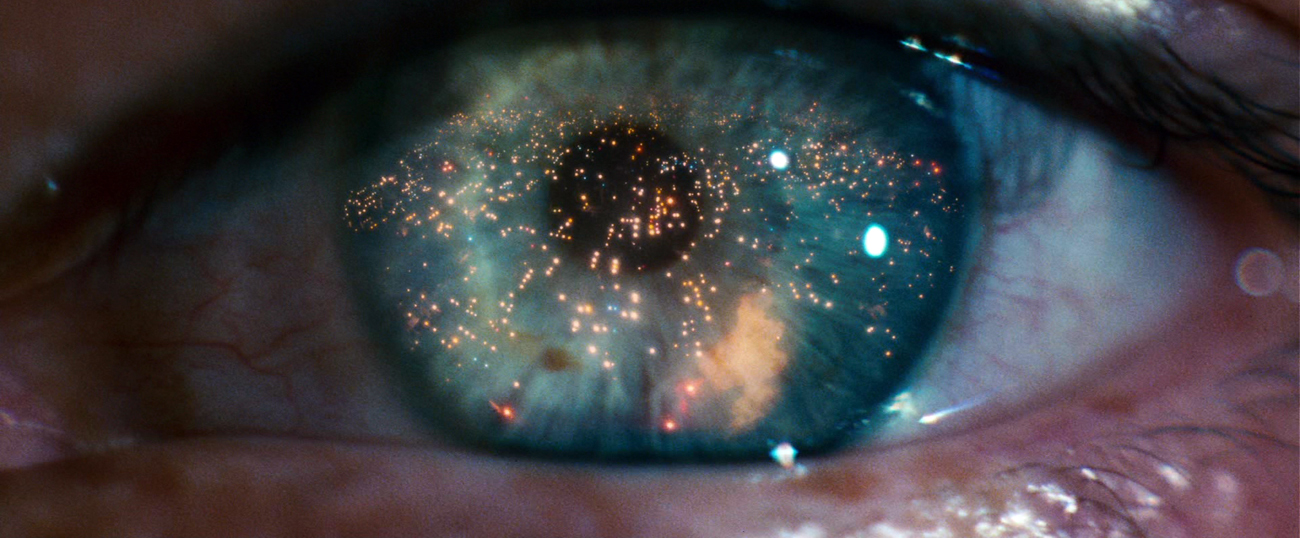
Finally, I see the eyes as the transgression of the boundary between human and machine. The eyes are clearly from humans put into these replicant machines. Because the replicants aren't human and aren't supposed to have emotions, their involuntary emotional responses displayed in their eyes are not the same as a humans.
Eyes
In the movie Blade Runner, I believe the reoccurring symbolism of eyes is a reference
to a person’s memories and experiences. Humans use their eyes to witness the
world. The things we see and experience are remembered and in turn make us who
we are. I remember the last replicant to die, Roy, mentioned that all his
experiences would be lost when he dies. Those experiences that make him unique would
be forgotten. These same memories and experiences help form what we know as the
soul. But do cyborgs have souls? This seems to be one of the main themes of the
film. The common phrase “the eyes are the windows of the soul” becomes very
relevant in this regard. When the replicants question the Asian eye
manufacturer, they learn that Tyrell made their mind. It is not mentioned who
made their soul, begging the question if a soul can even be manufactured.
Towards the end of the film when Roy confronts Tyrell and is denied a longer
life, he grabs Tyrell’s head and stares into his eyes. He must have seen
something terrible or perhaps nothing at all, as he gouges out Tyrell’s eyes. I
interpret this as Roy saying that Tyrell, his creator, has no soul as he
created a life that is doomed to a short existence. Tyrell is more obsessed
with scientific advancement than about the lives his creations have. The events
of the film make me think that the replicant’s had souls, or at least thought
they did.
I would like to finish off with saying that I very much
enjoyed the movie as I had never watched it and always heard great things about
it. The movie was a bit cryptic at times, but that just added to the dark,
mysterious tone of the film. The flying cars also reminded me of The Fifth Element; another great movie
if you haven’t seen it yet.
Bladerunner: Eyes & Other Musings
Firstly, I thoroughly enjoyed the film, as I do with most sci-fi films I come across. I also loved the combination of futuristic sci-fi with film noir.
Moving on, the eyes are a powerful tool used in this movie to poke and prod our conception of what makes and defines us as human. Eyes in human culture are very important in giving of visual cues as to how we are feeling, and they are also often associated with the soul and truth in the form of the phrases, "The eyes are the portal to the soul" and "If you want to know if I'm telling the truth, look into my eyes". These two phrases and similar sayings are popular and well known across humanity, and that is because the face, especially the eyes, are used as a universal communicator to tell others who we are and how we are feeling, regardless of our nationality, culture, or language barriers. This method of communication is also something used to commonly contrast what makes us human, and not say a cyborg or robot. Our eyes and faces are capable of showing emotions we feel and communicating this with others, where as robots and cyborgs are normally shown to have stoic facial expressions, regardless of whether or not they can feel and process emotions. Now in the movie, the replicant Rachel provides an example of something that can feel and process emotion(we think), that does not or possibly can't display that emotion on her face and in her eyes. From what I observed, I didn't see her facial expression change once during the entire film.
Another thing I found strange, was how the replicants found themselves flawed because they had such short life spans, yet their creators idolized them as being "perfect". Tyrell and Sebastian both remark at how beautiful the replicants are and how they are better and superior to humans in almost every way conceivable. It's almost as if Tyrell and Sebastian can't even manage to sympathize with the replicants because they find them to be perfect because they are better than humans.
Ucann-eyes
Thinking about the frequent focus that Bladerunner placed on eyes, I was brought back to the Sigmund Freud essay The Uncanny that we read. Freud spends a large amount of time dissecting the common references to the eyes in The Sandmen, and I decided I would try and connect his analysis to the importance of eyes in Bladerunner.
To start, we can see the relation between humans and replicants is similar to that of to that of parents and child, as creator and creation. Using Freud's idea of the Castration Complex and the Oedipus Complex, we know that there is a subconscious fear of damage to the eyes, which he theorized to be a stand in for the male member. From there, he explains, the fear of damage to the eyes, and therefore the male member as well, is rooted to the fear of castration at the hands of the father. This leads to the the understand that Nathaniel's father and Coppelius must be halves of the true father, wherein the loving relationship between father and son is separated from the aspect of the father responsible for the castration anxiety in Nathaniel.
Comparing this idea to the paradoxical interaction between Batty and Tyrell. Instead of splitting Tyrell into two separate figures, we see the contrasting behavior. While at first the father-son relationship is clear, with Tyrell showing pride in what Batty has done and become, and Batty as the scared child needing protection from his fate. We also see that Tyrell appeared to show great concern, and had researched and attempted to divine a method of prolonging the life of the replicants, showing that Tyrell views the replicants as more than a disposable product. although he admits that he has been unable to find a means. Batty begins to kiss Tyrell, before killing him, showing both immense love and incredible dread towards his "father".
To understand this, the importance of the eyes on the identity must be understood. By denying Batty prolonged life, Tyrell also denies Batty the possibility to be human. As the eyes are the indicator of someone as human or replicant, and therefore through Freud's understanding of the eyes as a substitute for the male member, we can see that Tyrell denying Batty his prolonged life was analogous to castration. Therefore, we can understand Batty's actions as rooted in the castration complex. This can be further supported in that Batty's means of killing also functioned as a destruction of Tyrell's eyes, which through Freud's ideas would be a revenge driven "eye for an eye" (literally) situation.
Although this is one example, it does illustrate why the eye is a recurring theme in Bladerunner. By creating the replicants with manufactured eyes, the Tyrell corporation had effectively castrated the replicants, and so their rebellion can be understood as both retribution for as well as an attempt at reverting their castration by their creators.
To start, we can see the relation between humans and replicants is similar to that of to that of parents and child, as creator and creation. Using Freud's idea of the Castration Complex and the Oedipus Complex, we know that there is a subconscious fear of damage to the eyes, which he theorized to be a stand in for the male member. From there, he explains, the fear of damage to the eyes, and therefore the male member as well, is rooted to the fear of castration at the hands of the father. This leads to the the understand that Nathaniel's father and Coppelius must be halves of the true father, wherein the loving relationship between father and son is separated from the aspect of the father responsible for the castration anxiety in Nathaniel.
Comparing this idea to the paradoxical interaction between Batty and Tyrell. Instead of splitting Tyrell into two separate figures, we see the contrasting behavior. While at first the father-son relationship is clear, with Tyrell showing pride in what Batty has done and become, and Batty as the scared child needing protection from his fate. We also see that Tyrell appeared to show great concern, and had researched and attempted to divine a method of prolonging the life of the replicants, showing that Tyrell views the replicants as more than a disposable product. although he admits that he has been unable to find a means. Batty begins to kiss Tyrell, before killing him, showing both immense love and incredible dread towards his "father".
To understand this, the importance of the eyes on the identity must be understood. By denying Batty prolonged life, Tyrell also denies Batty the possibility to be human. As the eyes are the indicator of someone as human or replicant, and therefore through Freud's understanding of the eyes as a substitute for the male member, we can see that Tyrell denying Batty his prolonged life was analogous to castration. Therefore, we can understand Batty's actions as rooted in the castration complex. This can be further supported in that Batty's means of killing also functioned as a destruction of Tyrell's eyes, which through Freud's ideas would be a revenge driven "eye for an eye" (literally) situation.
Although this is one example, it does illustrate why the eye is a recurring theme in Bladerunner. By creating the replicants with manufactured eyes, the Tyrell corporation had effectively castrated the replicants, and so their rebellion can be understood as both retribution for as well as an attempt at reverting their castration by their creators.
Bladerunner: Eyes and Other Organs.
As mentioned eyes play an important role in the movie. I'd like to point out that the person Roy and Leon target first is the person who created their eyes. This is important since eyes are often thought of as windows into the soul. There must have been multiple people that could have had the information they needed however they chose to go after the one that figuratively gave them their souls. This shows the replicants innate connection to human ideas. Roy and Leon are starting to break down the line that separates the humans for the replicants, the artificial from the organic. Another important scene is when Roy kills his creator Eldon Tyrell by gouging his eyes. The chosen method of murder was to destroy the window to Eldon's soul. Roy is literally destroying what figuratively makes Eldon a human. This again shows Roy's innate connection to human idea's and his attempt to break the line between human and replicant.
Rachel represents a fear of being inhuman and a confusion of what she actually is. She comes to
Deckard in an attempt to prove to him that she's a human. As Eldon says he thinks she is starting to suspect that she is a replicant. But even with this suspicion she tries to prove that she's not and that she's a human. This stems from a human fear of being not human. From this also comes a confusion of what a human really is. She has memories of a childhood. She has emotions. She's for all intent and purposes a human... but she's not. In our present world this confusion is starting to grow more and more. We've developed artificial heart valves and are on the verge of complete artificial organs. If someone were to have one of these organs implanted within them would they still be a human? This creates a confusion in what a human is. This same idea can be applied to all technology. Am I human even though I'm using this computer? Am I human even though I use rocks and sticks as a weapon? What's the really difference between an artificial organ and a sharpened stick besides the level of technology? Both of them are used to keep their user alive. In the movie the character Rachel forces us to think about this. She confuses the line between human and cyborg.
Rachel represents a fear of being inhuman and a confusion of what she actually is. She comes to
Deckard in an attempt to prove to him that she's a human. As Eldon says he thinks she is starting to suspect that she is a replicant. But even with this suspicion she tries to prove that she's not and that she's a human. This stems from a human fear of being not human. From this also comes a confusion of what a human really is. She has memories of a childhood. She has emotions. She's for all intent and purposes a human... but she's not. In our present world this confusion is starting to grow more and more. We've developed artificial heart valves and are on the verge of complete artificial organs. If someone were to have one of these organs implanted within them would they still be a human? This creates a confusion in what a human is. This same idea can be applied to all technology. Am I human even though I'm using this computer? Am I human even though I use rocks and sticks as a weapon? What's the really difference between an artificial organ and a sharpened stick besides the level of technology? Both of them are used to keep their user alive. In the movie the character Rachel forces us to think about this. She confuses the line between human and cyborg.
Bladerunner
First of all, I had enjoyed the movie very much although some scenes were a little much violence and grotesque.
The meanings of eyes can be the symbol of human being, life, and truth. Eyes have been considered as the symbol of truth in many diverse cultures. They always have a power to tell some messages. In the movie, characters seemed like that they communicate with their eyes rather than languages. Although the replicants did not have any emotion, the 6 replicants are able to have the emotion. To tell this emotion, the characters use the eye contacts to send the true messages with their emotions.
In the file, the replicates have been created and used as the slaves. As well as, the female replicants seem described as a female only when they try to sexually approach to other male characters. At the end of her article, Haraway says that "I would rather be a cyborg than a godless" (Haraway p.181). Haraway might think that the in the terms of working or being a labor force, it is easier to lose the emotion and being a female. Thinking about "who am I" or "what am I doing" kind of question for the meaningless work as a slave makes the person (or cyborg) confused. It is more simple and easy not to think about those things and just keep working. In fact, in the Bladerunner, the replicants realized that and needed to fight towards human beings.
Subscribe to:
Posts (Atom)
